
Hardwood vs Luxury Vinyl Plank Flooring: Which Should You Choose?
Flooring is one of the most visible and most lived-in elements of a home, and the choice between hardwood and luxury vinyl plank (LVP) comes up in almost every kitchen or whole-home renovation conversation. Both materials have genuine advocates, both have gotten meaningfully better in recent years, and both are now available at a wide enough range of price points that neither is simply the budget or premium option. The choice depends on specific circumstances rather than a simple hierarchy of quality.
Luxury vinyl plank has improved dramatically over the past decade. Early generations of vinyl flooring had a plasticky appearance and a hollow sound underfoot that made them feel like a compromise. Modern LVP with embossed surfaces, wood-grain texture registration, and multiple layers of construction has genuinely narrowed the gap with hardwood in appearance while maintaining advantages that hardwood simply cannot match in certain environments.
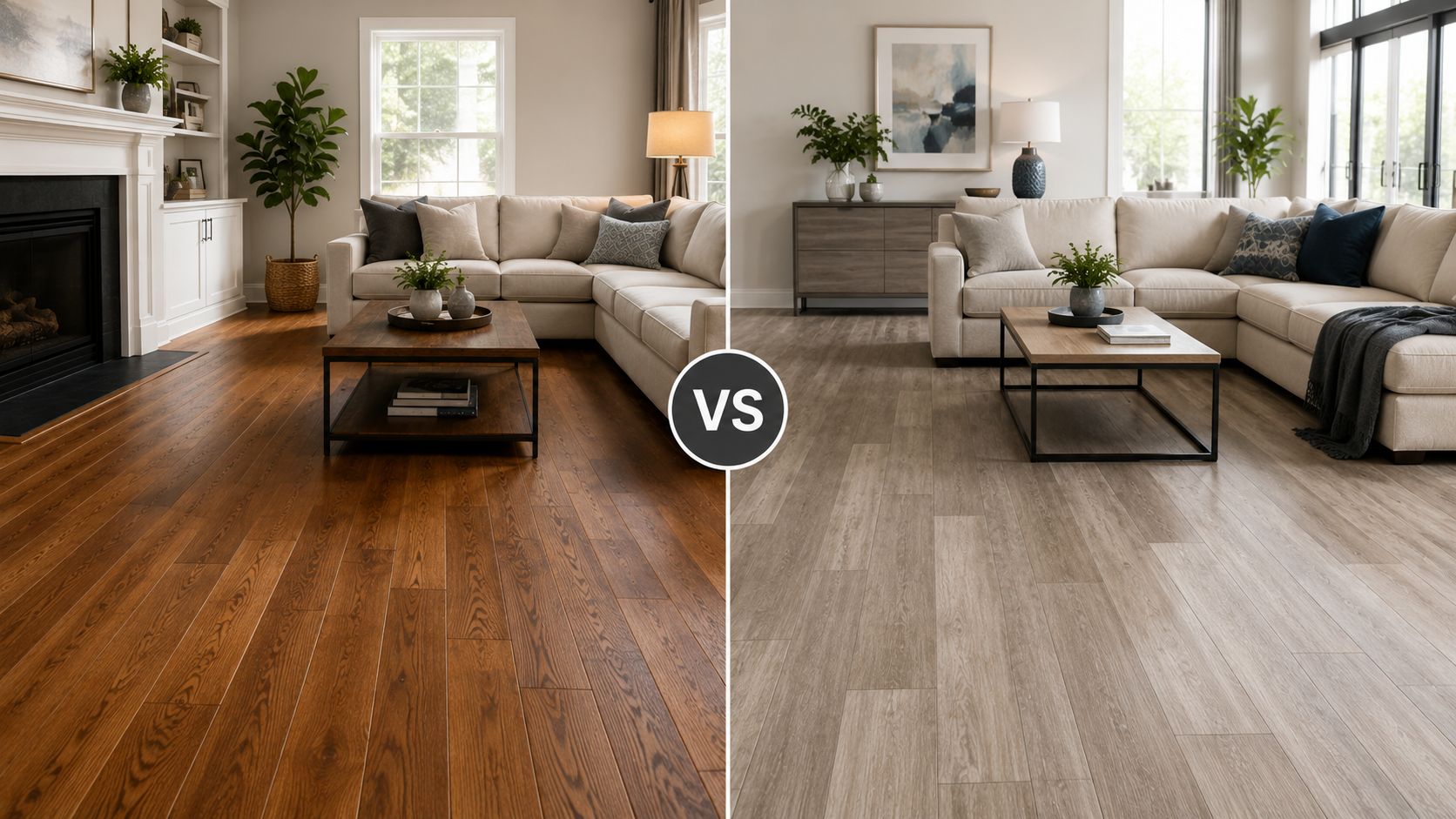
Quick Answer: Hardwood flooring offers warmth, longevity, and the ability to be sanded and refinished multiple times, making it an excellent long-term investment in low-moisture environments. Luxury vinyl plank is waterproof, more resistant to dents and scratches, more comfortable underfoot in some constructions, and significantly less expensive both to purchase and install. Hardwood suits main living areas, bedrooms, and dining rooms. LVP is the stronger choice for kitchens, bathrooms, basements, and any area with moisture risk.
Material Composition and What It Means
Solid hardwood is exactly what it sounds like: planks milled from solid wood throughout their thickness. Engineered hardwood has a real wood veneer over a plywood or HDF core, which gives it better dimensional stability in response to humidity changes while maintaining a genuine wood surface. Both are natural materials with the warmth, variation, and feel that comes with that.
Luxury vinyl plank is a synthetic product typically constructed in four or five layers: a rigid or flexible core (often stone polymer composite or wood polymer composite in premium products), a photographic film layer that creates the visual pattern, a wear layer that determines scratch resistance, and sometimes an attached underlayment for sound and comfort. The construction varies significantly by price point, and the quality difference between entry-level and premium LVP is much larger than the price difference would suggest.
Durability: Where Each Wins
Hardwood is durable in the sense of longevity: a well-maintained solid hardwood floor can last a century or more. It is not, however, particularly resistant to moisture, dents from dropped objects, or scratching from pets and heavy furniture movement. Hardwood that gets regularly wet, even from cleaning water, eventually warps, stains, and deteriorates at the joints. Soft wood species like pine and American cherry dent relatively easily. Even harder species like hickory and maple show wear over years of daily use.
The significant advantage is refinishing: a hardwood floor that has become scratched, stained, or worn can be sanded back to fresh wood and refinished. A solid hardwood floor can typically be refinished five to eight times over its lifespan, which is what gives it such extraordinary longevity. Engineered hardwood can be refinished two to four times depending on the veneer thickness.
LVP's durability profile is different. It is waterproof, which makes it suitable for environments where hardwood would be a liability. High-quality LVP with a thick wear layer resists everyday scratching and denting better than many hardwood species. The limitation is that it cannot be refinished: when the wear layer is through, the floor needs replacement. Premium LVP products have wear layers thick enough that this may not become relevant for fifteen to twenty years of residential use.
Feel and Sound Underfoot
This is the dimension where hardwood retains a clear qualitative advantage. The feel of walking on a genuine wood floor is distinct: slightly resilient, warm to the touch, and with a sound character that most people find pleasant. Thicker solid hardwood floors have a particularly satisfying acoustic quality.
LVP can feel harder and sound hollow underfoot, particularly on products that do not include an attached underlayment. Premium LVP with a thicker core and attached padding is considerably better in this respect than thinner entry-level products. An additional underlayment beneath the LVP also significantly improves feel and sound attenuation, but it adds to the installation cost.
Moisture and Environment Suitability
This is where the choice often becomes straightforward. Hardwood is not appropriate for bathrooms, below-grade installations, or kitchens with frequent water exposure. Even engineered hardwood, which is more dimensionally stable than solid, has limits to the moisture it can handle without damage. Homeowners interested in low-maintenance surface options for kitchens and bathrooms consistently find that moisture-proof materials like LVP serve these spaces better than anything wood-based.
LVP is completely waterproof and appropriate for any environment in the home, including bathrooms, laundry rooms, basements, and kitchens. It can be installed below grade without the swelling and warping that would damage hardwood. For homeowners who want a consistent flooring material throughout the entire home including wet areas, LVP makes the unified look possible where hardwood cannot.
Installation and Cost
Hardwood installation requires acclimation of the wood to the space's humidity before installation, a clean level subfloor, and typically professional installation, particularly for nail-down solid hardwood. The installation labour for hardwood is higher than for LVP due to the additional precision required. Material costs for quality solid hardwood range from $5 to $12 per square foot; engineered hardwood runs $4 to $10 per square foot.
LVP is generally easier to install and lends itself to floating installation methods that do not require nailing or gluing. Many homeowners with basic skills install LVP themselves, though professional installation ensures the best results with expansion gaps, transitions, and subfloor preparation. Material costs for quality LVP run from $2 to $7 per square foot, with premium products at the higher end.
The decision between hardwood and LVP is one of many material choices that interact with each other in a remodel. The principles behind mixing materials in kitchens can guide a homeowner who wants different flooring in different areas of the home while maintaining visual cohesion across the whole space.
Resale and Home Value
Hardwood flooring consistently receives recognition in real estate appraisals and buyer surveys as a premium feature that adds measurable value to a property. The same broad durable material comparisons apply here: premium natural materials carry a perception of quality that synthetic alternatives, however good, do not yet match at equal price points in most buyers' minds.
Quality LVP has improved the perception gap significantly and is now considered a desirable feature in many market segments, particularly in kitchens and bathrooms where its practical advantages are most apparent. In the primary living areas of a home, however, buyers generally still prefer and pay a premium for genuine hardwood when both options are available in the same price range.
Frequently Asked Questions
Can LVP be installed over existing hardwood floors?
Yes, provided the existing hardwood floor is structurally sound, level, and not significantly raised already. LVP adds height to the floor, which can create transition issues with adjacent rooms. The existing hardwood must be flat within manufacturer tolerances, which may require grinding high spots or levelling compound for low spots.
How does temperature affect LVP versus hardwood?
LVP expands and contracts with temperature changes and requires adequate expansion gaps at walls and transitions. Solid hardwood responds more to humidity changes than temperature. Both materials need appropriate acclimation before installation. LVP's tolerance for temperature variation is generally better than hardwood's, making it a better choice for spaces with significant temperature swings.
Which is easier to repair if damaged?
Hardwood is easier to repair for small areas because individual boards can be replaced and the floor refinished to blend the repair. LVP is harder to repair invisibly because matching an existing floor after years of slight colour change from UV exposure is difficult. The better strategy for LVP is keeping a supply of extra planks from the original batch.
Does LVP work with radiant floor heating?
Many LVP products are compatible with radiant floor heating, but the specific product must be rated for this application and the maximum temperature limits must be respected. Check manufacturer specifications before installation over radiant heat. Not all LVP products are suitable, and using an incompatible product can cause warping and delamination.
What thickness of LVP should I choose?
For residential applications, 6mm to 8mm LVP is adequate for smooth subfloors. 8mm to 12mm products with attached underlayment provide better sound attenuation, better feel underfoot, and more tolerance for minor subfloor imperfections. The thicker options cost more but produce a noticeably better result in most installations.
The Bottom Line
Hardwood and luxury vinyl plank serve different needs well. Hardwood remains the premium choice for living areas, dining rooms, and bedrooms where longevity, natural beauty, and real estate value are priorities. LVP is the more practical choice for kitchens, bathrooms, basements, and any space where moisture, heavy use, or budget are primary concerns.
Kitchen Discounters can help you navigate the flooring decision as part of a broader kitchen or whole-home renovation plan. Get in touch or visit to discuss what works best for your project.