
Quartz vs Granite Countertops: Which Is Better for Your Kitchen?
Choosing between quartz and granite is one of the decisions that comes up in almost every kitchen remodel conversation, and for good reason. Both are widely used, both are beautiful, and both are genuinely durable materials that hold up well in a kitchen environment. The choice is not between good and bad: it is between two good options that suit different priorities, different lifestyles, and different kitchen designs. Understanding how they actually differ makes the decision considerably easier.
The materials appeal for different reasons. Granite is a natural stone with the unique variation that comes from geological processes spanning millions of years. No two slabs are identical, which is part of its appeal. Quartz is an engineered composite made from crushed stone bound with resin and pigments, which means it can be produced in virtually any colour and pattern with consistent results across multiple slabs. Both have genuine advantages depending on what matters most to you.
Quick Answer: Neither quartz nor granite is universally better. Quartz is the stronger choice if you want a low-maintenance countertop that does not require sealing and is more resistant to staining. Granite is the better choice if you want the unique character of a natural stone and are willing to maintain it with occasional sealing. For active family kitchens with heavy use, quartz tends to be the more practical day-to-day choice. For design-focused kitchens where natural variation is a priority, granite often wins.
Composition and What That Means in Practice
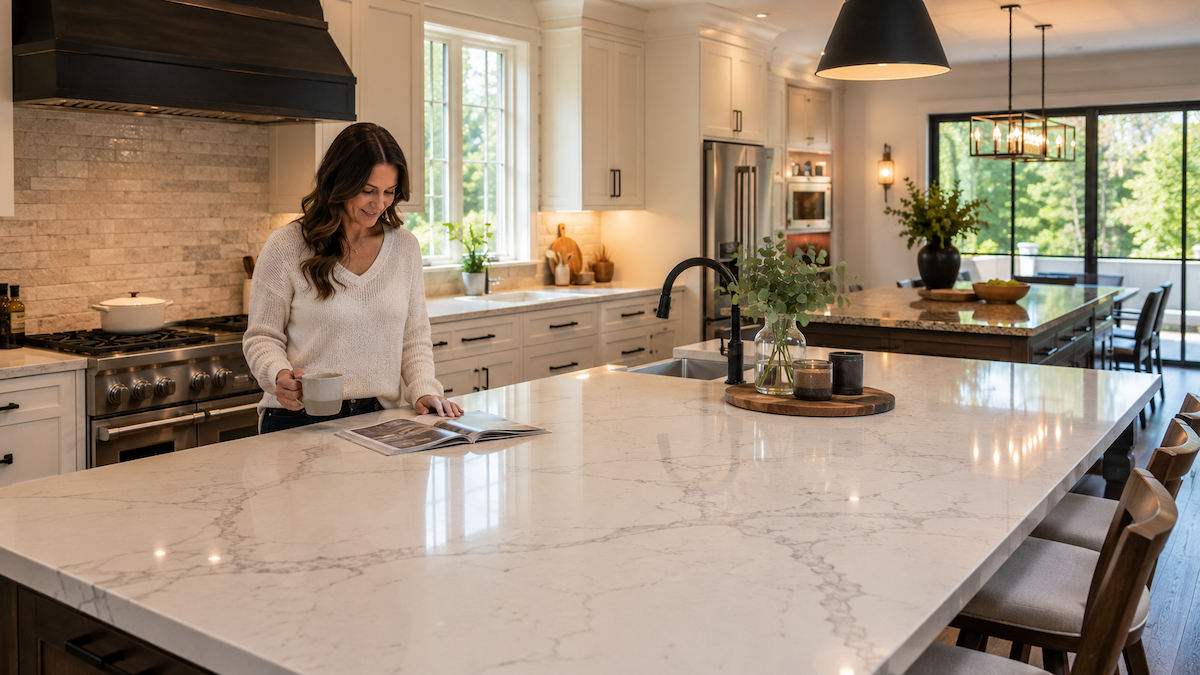
The fundamental difference between these materials is that quartz and granite differ in composition in a way that directly affects their performance: granite is a natural stone formed from cooled magma, while quartz countertops are engineered from approximately 90 to 95 percent crushed quartz stone bound with polymer resin.
This difference in composition is why quartz is non-porous and granite is not. Natural stone, including granite, has a porous surface that absorbs liquids over time unless it is treated with a sealant. An unsealed granite countertop can absorb wine, oil, and acidic foods and develop staining or odour if not cleaned promptly.
Quartz's resin binding creates a non-porous surface that does not require sealing and resists staining from virtually all household liquids. For a kitchen that sees heavy daily use and cooking involving oils, wine, or strongly coloured ingredients, this practical difference is meaningful.
Durability: How They Hold Up to Daily Use
Both materials are durable, but they have different vulnerability profiles. Granite is very hard and highly heat resistant: you can place a hot pan directly on a granite countertop without risk of damage. It is resistant to scratching from knives and normal kitchen activity. Its vulnerability is to cracking or chipping under significant impact, particularly at unsupported edges.
Quartz is also very hard and highly scratch resistant. Its main vulnerability, which granite does not share, is heat sensitivity. The polymer resin in quartz can be damaged by sustained high heat, so placing hot pans directly on quartz without a trivet is not recommended. Over time, repeated heat exposure can cause discolouration or cracking near the edges. This is a practical daily consideration in any active cooking kitchen.
For households where baking and cooking are frequent and pots and pans move directly from stove to counter, granite's heat resistance is a genuine practical advantage. For households that are more relaxed about sealing and maintenance schedules, quartz's low maintenance requirement may outweigh the heat consideration.
Maintenance: Sealing, Cleaning, and Long-Term Care
The maintenance difference is one of the clearest practical distinctions. Quartz has become the more popular choice in modern kitchens partly because its non-porous surface requires no sealing, and cleaning is as simple as soap and water or a mild countertop cleaner.
Granite requires periodic resealing, typically once a year or so depending on the porosity of the specific stone and the type of sealant used. It is not a significant task, but it is a maintenance commitment that quartz simply does not have. A simple water test, whether water beads on the surface or absorbs, tells you whether a granite countertop needs to be resealed.
For homeowners who want the most hands-off countertop experience, low-maintenance countertop options consistently point to quartz as one of the most practical choices, alongside other engineered surfaces that share the same non-porous quality.
Aesthetics: Natural Variation Versus Consistent Colour
Design preference is often what ultimately tips the decision between these two materials. Granite offers something quartz cannot: the genuinely unique, one-of-a-kind character of a natural stone slab. Every piece of granite is different, with its own particular veining, mineral patterns, and colour distribution. This natural variation is something many homeowners find deeply appealing, particularly in kitchen designs that aim for a grounded, organic aesthetic.
Quartz's engineered nature means consistent colour and pattern across multiple slabs, which is useful when matching sections of an island to a perimeter or ensuring consistent appearance across a complex layout. Matching the countertop colour to the kitchen is typically more predictable with quartz, because the colour you see in the showroom is very close to what will arrive on site.
The range of available colours also differs. Granite is limited to what natural stone produces, which is considerable but ultimately constrained by geology. Quartz can be produced in virtually any colour, including whites, greys, and solid colours that do not exist in natural stone, as well as patterns that mimic marble, concrete, and other materials.
Cost: What to Expect
Both materials occupy a similar price bracket at mid-range quality levels, though there is significant variation within each. Entry-level granite slabs can be quite affordable, while rare or exotic granite varieties can cost substantially more.
Countertop selection at the design and material stage involves understanding not just the surface cost but the full installed price including fabrication, edge profiling, and installation.
Mid-range quartz from reputable manufacturers tends to be priced similarly to mid-range granite. Premium quartz with thicker slabs or designer patterns commands a higher price. The installed cost difference between a comparable quartz and granite countertop in a typical kitchen is often less significant than homeowners expect.
Frequently Asked Questions
Does granite require more maintenance than quartz?
Yes. Granite needs to be sealed periodically to prevent staining and absorption of liquids. The frequency depends on the specific stone and the sealant used, but once a year is a common recommendation. Quartz requires no sealing and only basic cleaning with soap and water.
Can I put a hot pan on a quartz countertop?
It is not recommended. The polymer resin in quartz countertops can be damaged by sustained direct heat, which can cause discolouration or cracking. Always use a trivet or hot pad between a hot pan and a quartz surface.
Which is better for resale value, quartz or granite?
Both are considered premium countertop materials and both add comparable value to a home. Buyer preference for one over the other varies by market and design trend, but neither is a significantly better resale investment than the other at similar quality levels.
Can granite crack?
Yes, though it is unlikely under normal use. Granite can crack if subjected to significant impact or if improperly installed without adequate support. It can also chip at edges and corners. Granite is more susceptible to cracking than quartz under impact, though both materials are very durable.
Is quartz or granite better for a white kitchen?
Quartz is generally the more practical choice for a white kitchen because engineered white quartz is consistent in colour across the full slab and does not require the periodic sealing that white granite does. White granite can stain more visibly if not maintained carefully.
The Bottom Line
Quartz and granite are both excellent countertop materials. Quartz wins on maintenance simplicity and colour consistency. Granite wins on heat resistance and the unique character of natural stone. The right choice depends on how you cook, how much maintenance you are willing to do, and which aesthetic priority matters more to you.
Kitchen Discounters offers a full range of quartz and granite countertop options and can walk you through the specific slabs available for your project. Get in touch or visit to see the options in person and make the choice that fits your kitchen.