
How Can I Design a Kitchen That Supports Entertaining?
Kitchens have become the social centre of the home. In the decades since open-plan living became the dominant format for new builds and renovations, the kitchen has stopped being a back-of-house service space and started being a front-of-house gathering place. Guests congregate there naturally, conversations happen at the island, and the cook is expected to be part of the social occasion rather than sequestered behind a wall. Designing for this reality requires thinking about more than just the cooking process.
The challenge is that cooking and entertaining place competing demands on the same space. Cooking needs clear zones, good traffic flow between appliances, and adequate worksurface. Entertaining needs space for people to stand and move comfortably, seating options at varying heights, storage that keeps the visible surfaces clear, and an atmosphere that feels welcoming rather than purely functional. A kitchen that handles both well does not happen by accident; it is the product of decisions made specifically with both functions in mind.
Quick Answer: Design a kitchen for entertaining by prioritising a layout that separates the cooking zone from the guest zone, adding an island or peninsula with seating on the guest side, investing in storage that keeps worksurfaces clear during prep, and creating an atmosphere with lighting and finish choices that make the space feel welcoming when it is full of people. The goal is a kitchen where the cook can be present and social while still having the space and focus to get dinner on the table.
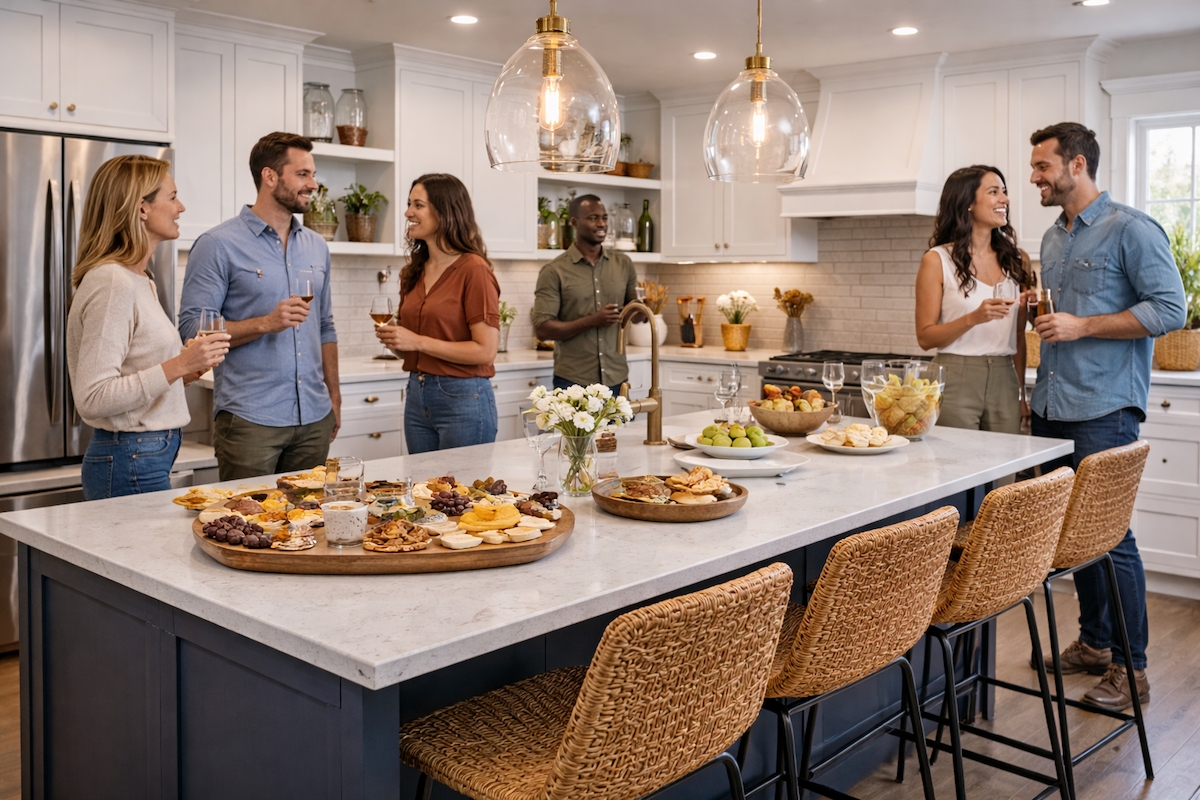
Layout: Separating the Cook Zone From the Guest Zone
The most fundamental entertaining design principle is the clear separation between where active cooking happens and where guests stand. In a kitchen without this separation, guests instinctively crowd the cooktop and the main prep counter, which creates a traffic management problem exactly when focus and space are most needed.
An island or peninsula solves this structurally. The cook faces outward toward the island, working at a perimeter counter behind them or on the island surface itself, while guests sit or stand on the opposite side. The island acts as a natural barrier that positions guests helpfully rather than obstructively. It also creates a surface at which people can eat, drink, and graze while the cooking is in progress.
The configuration of the island, its size, whether it is fixed or rolling, and whether it includes seating on one or both sides, are decisions that benefit from careful thought before committing. What to know before adding an island covers the key decisions including clearance requirements, overhang dimensions for seating, and whether a fixed or flexible island suits your space better.
Traffic Flow: Keeping Guests and Cooks From Colliding
A kitchen that works well for two people working together on a regular weeknight can feel chaotic the moment six guests are added to the equation. Managing traffic flow in an entertaining context means thinking about how people move between the kitchen and adjacent areas, where drinks and snacks are accessed, and whether there are natural bottlenecks that will cause problems when the space is full. Improving traffic flow in a busy kitchen is directly applicable to entertaining design because the challenges are structurally identical.
The position of the refrigerator is particularly relevant here. Guests frequently open the refrigerator for drinks without asking, which is fine in principle but problematic if the refrigerator is positioned inside the main cooking zone. A refrigerator drawer or a secondary drinks fridge positioned on the guest side of the island eliminates this conflict entirely.
Designing for Multiple Cooks
Entertaining kitchens are rarely single-cook environments. Whether it is a partner or a close friend who wants to help, the kitchen needs to accommodate two people working in the same space without them constantly stepping around each other. Designing for multiple cooks covers the spatial requirements, including minimum aisle widths and the separation of prep stations, that make two-cook cooking genuinely workable.
Two sinks are a significant functional upgrade in an entertaining kitchen. A main sink in the primary cooking zone and a prep or bar sink on the island allows one person to handle food prep while another manages drinks and washing up simultaneously, without either person having to give way. The cost of a second sink installation is modest relative to the functional improvement it delivers.
Storage That Supports Hosting
Nothing undermines the mood of an entertaining kitchen faster than visual clutter. The prep for a dinner party generates a volume of equipment, ingredients, and packaging that can overwhelm a normally tidy space in minutes. Storage designed specifically for this reality keeps the mess off the surfaces and behind doors, which allows the kitchen to look presentable while still functioning hard.
This means deep pantry storage for bulk ingredients and large-batch equipment, dedicated drawers for serving pieces, and counter organisation systems that allow frequently used items to stay accessible without cluttering the visible surface. Storage solutions for a clutter-free kitchen includes specific strategies for exactly this kind of high-volume, high-activity kitchen use.
A concealed pull-out rubbish and recycling station within the island base is another practical investment for entertaining. It allows prep waste to disappear immediately without carrying it across the kitchen or leaving it visible, which keeps the island surface clear and the kitchen looking composed even mid-service.
Beverage Stations and Self-Serve Zones
One of the most effective structural decisions for an entertaining kitchen is creating a self-serve zone for drinks and light snacks that is accessible without entering the cooking area. When guests can help themselves to drinks, ice, and something to nibble on without asking or reaching across the cooking zone, the cook's concentration is protected and guests feel comfortable rather than dependent.
A built-in coffee station is a natural component of this setup. How to incorporate a coffee station into the kitchen layout covers the spatial requirements and the specific appliance and storage combinations that make a genuinely functional station rather than a decorative one.
A wine fridge or drinks fridge built into the island base, combined with a pull-out drawer for glasses and a section of counter space dedicated to drink preparation, creates a self-contained hospitality zone that handles most of what guests need without any intervention from the person cooking.
Lighting and Atmosphere
Cooking lighting and entertaining lighting are different things. Task lighting needs to be bright and focused. Entertaining lighting needs to be warm and adjustable. Designing a kitchen for both functions means installing lighting on separate circuits or with dimmer controls so the same kitchen can shift from functional workshop to welcoming social space depending on the occasion.
Layered lighting is the key to this. Pendant lights over the island set the atmosphere. Under-cabinet lights support the task work. Recessed lights provide the overall illumination that can be dimmed as the evening moves from cooking to eating. Lighting for function and ambiance covers the specific layer structure that makes this work in practice.
Frequently Asked Questions
How much space do I need for an island with seating?
The standard recommendation is a minimum of 42 inches of clearance between the island edge and any parallel surface such as a counter or wall. For seating on the island, an overhang of at least 12 inches is needed for knee clearance, with 15 inches providing more comfortable seating for an extended period.
Is an open-plan layout necessary for an entertaining kitchen?
It is not strictly necessary, but a connection between the kitchen and the main living or dining area significantly improves the entertaining experience. Even a partial opening between a closed kitchen and an adjacent room, such as a wide pass-through or a removed wall section, changes the social dynamic considerably.
What appliances are most useful in an entertaining kitchen?
A double oven or double oven with warming drawer for large-batch cooking, a separate drinks refrigerator, a dishwasher with a fast cycle for mid-event clearing, and a warming drawer for keeping served dishes at temperature are among the most practically useful appliances for regular entertaining.
How do I keep the kitchen looking presentable during a party?
Keep counter storage generous enough that everything has a home, designate a concealed area for prep mess such as a large island sink with a cover, use a few attractive bowls and boards to make staged ingredients look intentional rather than chaotic, and dim the lights slightly to create atmosphere without sacrificing visibility.
What countertop material is best for an entertaining kitchen?
Quartz is often recommended for entertaining kitchens because it is non-porous, resistant to staining from wine and oils, easy to clean mid-event, and available in large format slabs that minimise visible seams. Marble is beautiful but requires more careful management at a busy party.
The Bottom Line
A kitchen that supports entertaining does so by solving a layout problem: keeping the cook present and social while giving guests room to be there too. The island, traffic flow, storage, lighting, and a self-serve drinks zone are the tools that make this work.
Kitchen Discounters specialises in designing and building kitchens that handle the real demands of how people live, including entertaining. Get in touch or visit the showroom to talk through what your kitchen needs to support the way you like to host.