
How Do You Edge a Countertop and Which Profile Looks Best?
The edge of a countertop is a small detail that runs through the entire kitchen. It affects how thick the surface appears, how it feels against the body, how easily crumbs wipe away, and whether the finished room reads as modern, traditional, or somewhere in between.
Countertop edges are shaped during fabrication after the layout, material, thickness, sink, and overhang have been confirmed. Some profiles are included with the material, while more detailed shapes or built-up edges may add fabrication time and cost. The best profile should fit the material and the way the kitchen is used, not simply look attractive in a sample.
Quick Answer: An eased edge or small bevel looks best in most kitchens because it is clean, practical, and easy to coordinate with modern or transitional cabinets. A full bullnose softens corners for family spaces, an ogee adds traditional detail, and a mitered edge creates a thicker modern look. The edge is cut and polished by a fabricator using the countertop template and the profile selected before installation.
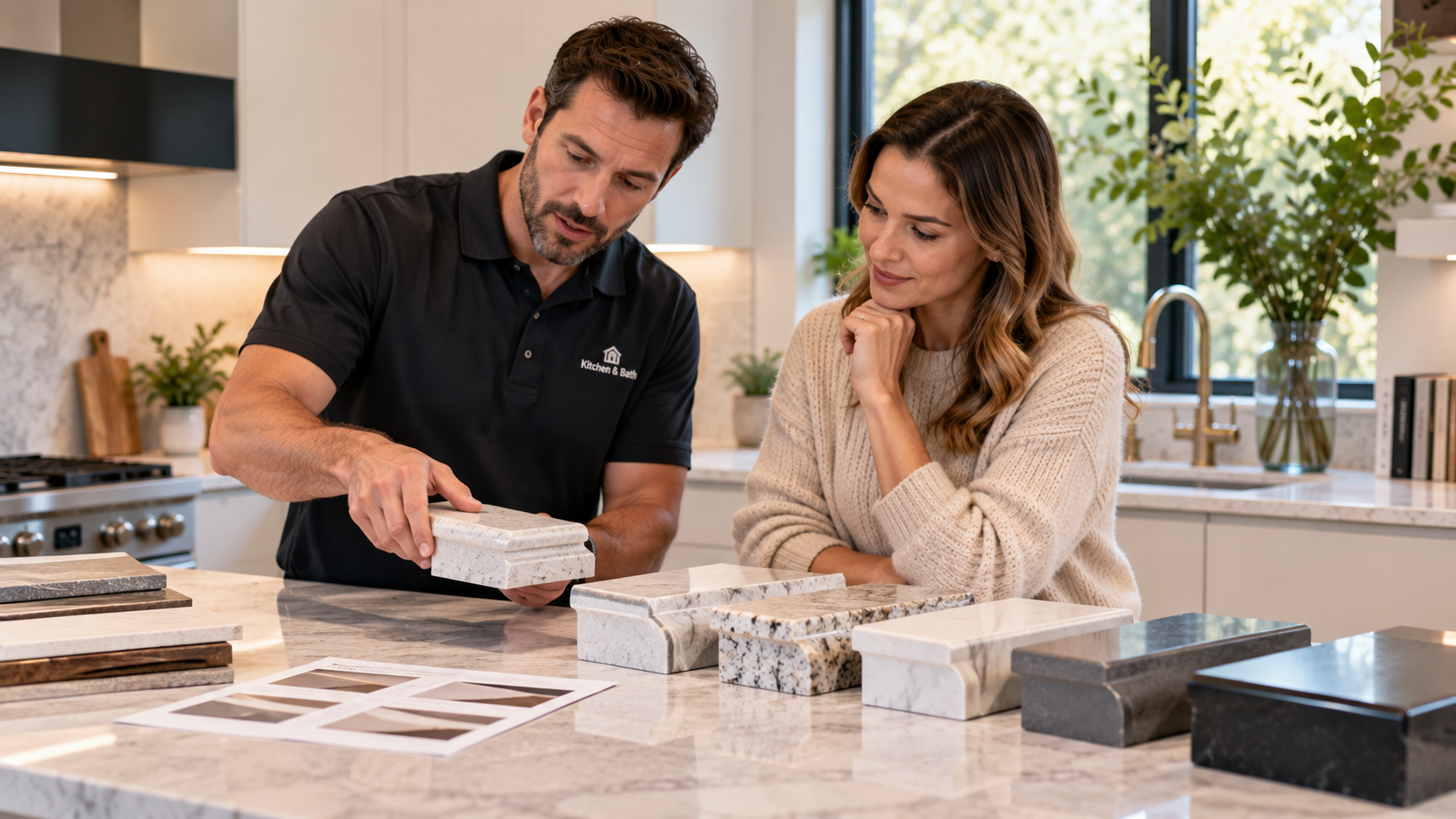
What Does It Mean to Edge a Countertop?
Edging means shaping and finishing the exposed side of a countertop slab. Fabricators cut the profile with specialized tools, refine the shape, and polish it to match the surface. The process must be consistent across straight runs, corners, overhangs, and visible ends.
Kitchen Discounters supplies and installs quartz and granite countertops along with solid-surface options. The available edge profiles depend on the material, slab thickness, manufacturer rules, and whether the design uses a standard edge or a built-up appearance.
Homeowners should select the edge before fabrication begins. Changing it after the slab has been cut can be difficult or impossible, especially around corners, sink openings, seams, and overhang supports.
How Is a Countertop Edge Made?
The process starts after base cabinets are installed, secured, and level. A precise template records wall conditions, corners, appliance spaces, sink location, faucet holes, seams, and overhangs. The fabricator transfers those measurements to the slab and plans the cuts.
A machine shapes the selected profile along exposed edges. The edge then moves through several polishing stages so its sheen and color match the top surface. Detailed profiles require more passes and more hand finishing than a simple eased edge.
The finished pieces are transported to the home, set on the cabinets, joined at planned seams, and secured. A coordinated kitchen remodeling plan helps ensure cabinets, appliances, sink, backsplash, and countertop dimensions are ready before templating and installation.
Which Countertop Edge Profiles Are Most Popular?
Eased Edge
An eased edge has a mostly square face with the sharp top and bottom corners softened slightly. It suits modern, transitional, and simple traditional kitchens. The clean shape shows the true thickness of the slab and is easy to wipe.
Beveled Edge
A beveled edge cuts a narrow angle along the upper corner. The angled line catches light and adds definition without the heavier decoration of an ogee. A small bevel feels restrained, while a wider bevel creates a stronger geometric statement.
Bullnose and Half Bullnose
A full bullnose rounds both the top and bottom edges. A half bullnose rounds the upper edge while leaving more of the lower face visible. These profiles soften the feel of the counter and can suit family kitchens, traditional rooms, and curved peninsula shapes.
Ogee Edge
An ogee uses an S-shaped curve to create a decorative shadow line. It works best with traditional or formal cabinetry and is often used on an island as an accent. The detailed shape takes more fabrication and needs slightly more attention when cleaning.
Mitered Edge
A mitered edge joins the horizontal top to a vertical front piece at an angled seam, making the counter appear much thicker than the slab. It is popular in contemporary kitchens and on islands, especially where a bold block-like look supports the proportions of the room.
Which Countertop Edge Looks Best in a Modern Kitchen?
An eased edge is the safest modern choice because it keeps the line simple and lets the countertop material remain the focus. A narrow bevel can add a little definition. A mitered edge works when the design needs more visual weight, especially on a large island.
Modern does not have to mean sharp. The corner should still be eased enough to remove a fragile point and make contact more comfortable. The exact radius can be subtle while preserving the square appearance.
Counter color and pattern affect the result. The guide to choosing countertop color can help coordinate the slab with cabinets, flooring, backsplash, and light. A quiet profile often suits bold veining, while a plain surface can carry a stronger edge detail.
Which Edge Looks Best in a Traditional Kitchen?
Traditional cabinetry can support profiles with more shape, including ogee, bullnose, and larger bevels. The edge should echo the level of detail in door panels, crown molding, hardware, and furniture without competing with every element.
An ogee can look elegant on an island or serving area, but using it on every run may feel heavy in a small room. Combining a decorative island edge with a simpler perimeter edge can control cost and keep the design balanced.
Reviewing finished countertop installations is more useful than judging a two-inch sample alone. Full-room images show how a profile reads from standing height and whether it suits the cabinet style and scale of the island.
What Is the Best Countertop Edge for a Busy Family?
An eased edge with softened corners is usually the most practical choice. It wipes clean easily, has fewer grooves, and works with almost any cabinet style. A bullnose is also comfortable against the body and removes the appearance of a sharp corner.
No stone edge is completely childproof, and rounded profiles do not make a hard countertop soft. Pay attention to outside corners, seating overhangs, walkway clearances, and the height of stools. A slightly rounded corner radius may matter more than the profile along a straight run.
Low-maintenance materials and simple edges often work well together. Kitchen Discounters' guide to low-maintenance countertop materials compares quartz, solid surface, laminate, stainless steel, and sealed granite for households that want easier routine care.
Does Countertop Material Limit the Edge Profile?
Yes. Natural stone and engineered quartz can support many routed profiles, but the slab thickness, pattern, and structural characteristics affect what is practical. Detailed edges may expose more of the aggregate or change how veining appears at the face.
Solid-surface materials can often create smooth integrated shapes and nearly invisible seams. Laminate uses manufactured edge treatments and may have different profile limits. Porcelain and ultra-compact slabs are thinner and require fabrication methods suited to the material.
The site's guide to selecting the right edge provides another overview of style, safety, maintenance, and material fit. Confirm the exact edge sample with the fabricator because profile names and dimensions can vary between suppliers.
How Do Thickness and Overhang Affect the Edge?
A standard edge shows the slab's actual thickness. A laminated or mitered edge can create a thicker appearance, but the added face must align carefully at corners and seams. Strong veining requires extra planning so the pattern looks intentional across the joined pieces.
Overhangs at seating areas need proper support based on the material, depth, and fabricator requirements. Edge shape does not replace brackets, corbels, or structural support. A dramatic thick edge can also reduce knee space if the proportions are not checked.
Cabinet scale matters too. A very thick mitered edge can overwhelm narrow cabinet doors, while a thin square edge may look underweight on a large island. Coordinating cabinet styles and finishes with the counter profile helps the two elements read as one design.
Do Decorative Countertop Edges Cost More?
They often do. Standard eased edges may be included with some materials or fabricators, while ogee, deep bevel, laminated, or mitered edges can add labor and material. Curves, detailed corners, and long island runs may also affect fabrication cost.
Ask for the edge charge as a separate line item and confirm whether it is priced by linear foot. Also ask how inside corners, outside corners, waterfall panels, seams, and sink edges are handled. A profile that looks affordable on a sample can become a larger cost across a long perimeter.
Use decorative edging where it has the greatest visual impact. An island facing the living area may justify more detail, while perimeter counters can stay simple. A countertop project consultation can confirm profile availability, pricing, and fit before the slab is ordered.
How Do You Choose the Final Edge Profile?
Start with the cabinet style and the feeling you want the kitchen to have. Then consider cleaning, children, seating areas, slab pattern, material thickness, and budget. View a full-size sample from standing distance and run your hand along the edge.
A practical selection guide is:
- Choose eased for broad style compatibility
- Choose bevel for a crisp light-catching line
- Choose bullnose for a softer rounded feel
- Choose ogee for traditional decorative detail
- Choose mitered for a thick modern appearance
Keep the profile consistent with the room rather than choosing the most complicated option available. The best edge is the one that supports the countertop, cabinets, and daily use without drawing attention for the wrong reason.
Frequently Asked Questions
What is the most popular countertop edge?
The eased edge is one of the most widely used profiles because it looks clean, works with many cabinet styles, and is easy to maintain. A small bevel is another versatile choice.
Which countertop edge is easiest to clean?
An eased or simple beveled edge is usually easiest because it has few grooves where crumbs and residue can collect. Detailed ogee profiles need a little more attention during wiping.
Is a bullnose edge outdated?
No. A bullnose can still suit traditional kitchens, curved counters, and family spaces that benefit from a softer line. Its rounded shape is less common in very minimal modern designs.
Can I change the edge after installation?
Usually not without removing and refabricating the countertop, and some changes are not possible once material has been cut away. Select and confirm the profile before fabrication.
Should an island have a different edge?
It can. A decorative or mitered island edge can create a focal point while perimeter counters use a simpler profile. The materials, color, and thickness should still feel connected.
Conclusion
An eased edge or small bevel looks best in most kitchens because it is simple, durable, and easy to coordinate. Bullnose, ogee, and mitered profiles can be excellent choices when the cabinet style, room scale, safety needs, and budget support them.
Kitchen Discounters can help homeowners compare countertop materials, edge samples, cabinets, and installation details before fabrication begins. Visiting the showroom is an easy way to see and feel the profiles at a useful scale.