
What Is Semi-Custom Cabinetry and How Does It Compare to Stock?
Cabinets usually take the largest share of a kitchen remodel budget, and they shape how the room looks and works every day. Once you start shopping, though, the choices quickly split into three tiers: stock, semi-custom, and custom. Each one promises something different on price, flexibility, and lead time.
For most homeowners, the real decision comes down to the first two. Full custom cabinetry makes sense for unusual spaces and generous budgets, but stock and semi-custom cover the vast majority of kitchens. Knowing where they differ helps you spend where it shows and save where it does not.
Quick Answer: Semi-custom cabinetry is factory-built from standard sizes but offers far more options than stock, including adjustable widths and depths, more door styles and finishes, and built-in storage inserts. Stock cabinets come in fixed sizes and limited styles, so they cost less and usually arrive faster. Semi-custom suits kitchens that need a better fit or more personality without the price of full custom.
What Are Stock Cabinets?
Stock cabinets are mass-produced in set sizes, typically in 3-inch width increments, and either kept in inventory or built quickly from a short menu. You choose from a limited range of door styles, colors, and box sizes, and what you see in the catalog is largely what you get.
That simplicity is their strength. Stock lines are the most budget-friendly option and often have the shortest wait. They work well for straightforward layouts, rental properties, laundry rooms, and kitchens where the walls are square and standard sizes fill the space neatly.
The tradeoff shows up in tricky rooms. When a wall does not match standard widths, installers close the gap with filler strips, and odd corners or soffits can leave wasted space behind.
What Is Semi-Custom Cabinetry?
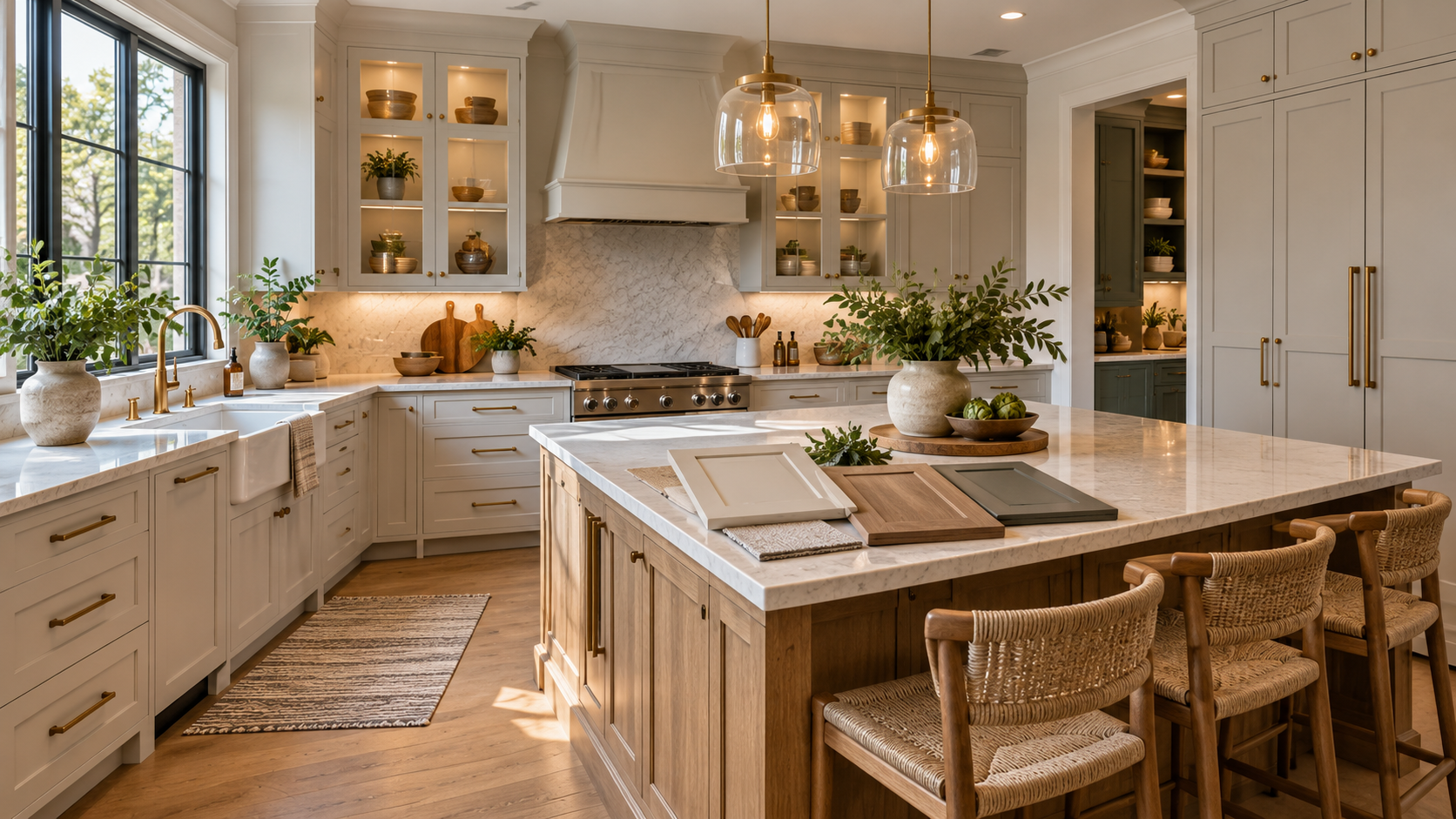
Semi-custom cabinets start from a manufacturer's standard catalog, but the line allows modifications. Common options include adjusting width or depth, changing cabinet heights, adding finished end panels, and choosing from a much larger range of door styles, wood species, paints, and stains.
Storage is where semi-custom often pulls ahead. Many lines offer roll-out trays, pull-out trash bins, spice and utensil inserts, and smarter corner solutions built into the cabinet rather than added afterward.
At Kitchen Discounters, the cabinetry lineup includes Fieldstone semi-custom cabinets alongside several other manufacturer lines, so homeowners can compare options in one place.
How Do Semi-Custom and Stock Cabinets Compare?
The two tiers share a lot. Both are factory-built, and both can look great when designed and installed well. The differences come down to fit, choice, and timing.
- Sizing: stock comes in fixed widths, while semi-custom allows adjustments to width, depth, and height.
- Style options: stock offers a short list of doors and finishes, while semi-custom opens up many more cabinet door styles and colors.
- Storage features: semi-custom lines typically include more built-in organizers and accessories.
- Lead time: stock is often the fastest option, while semi-custom is built to order and usually takes several weeks.
- Price: stock is the most affordable, while semi-custom costs more but stays well below full custom.
Construction quality varies by manufacturer more than by tier. Some stock lines are well built and some semi-custom lines cut corners, so look at box materials, drawer construction, and hinges rather than the label alone.
When Is Semi-Custom Cabinetry Worth the Extra Cost?
Semi-custom earns its price when your kitchen does not fit standard sizes neatly. Adjusting a few cabinets by an inch or two can eliminate filler strips, line up with windows, and make better use of every wall.
It also makes sense when storage and style matter as much as budget. If you want a specific paint color, a furniture-style island, or organizers that keep counters clear, semi-custom delivers those choices without building every box from scratch. Homeowners trying to maximize storage in a small kitchen often benefit most, since every inch counts.
Finish quality matters too. A durable cabinet finish holds up better in a busy kitchen, and semi-custom lines tend to offer more of those higher-grade options.
When Are Stock Cabinets the Smarter Choice?
Stock cabinets are a sensible pick when the layout is simple, the timeline is tight, or the budget needs to stretch toward countertops or appliances. A well-designed stock kitchen can look clean and current, especially with thoughtful hardware and lighting.
They also suit secondary spaces. Laundry rooms, garages, basements, and rental units rarely need the flexibility of semi-custom, and the savings there can go toward the main kitchen.
If your current cabinet boxes are still solid, a third path is worth comparing. Refacing existing cabinets replaces the doors and fronts while keeping the boxes in place.
How Do You Decide Which Tier Fits Your Kitchen?
Start with the room. Measure carefully, note any odd angles, soffits, or windows, and see how close standard sizes come to filling each wall. The more filler and wasted space a stock layout creates, the stronger the case for semi-custom.
Next, set a realistic budget for the whole project, not just cabinets. Knowing what a kitchen remodel costs in Lake County shows how cabinet choices affect everything else.
Finally, look at a design before you commit. A computer-aided layout shows how each tier fits your actual space, which makes it far easier to compare real options instead of catalog photos.
Frequently Asked Questions
Is semi-custom cabinetry the same as custom cabinetry?
No. Semi-custom cabinets start from a manufacturer's standard sizes and styles and allow set modifications. Custom cabinets are built from scratch to any size or design, which usually means higher cost and longer lead times.
Are semi-custom cabinets better quality than stock?
Not automatically. Quality depends more on the manufacturer and construction details, such as box material, drawer joinery, and hardware, than on the tier. Semi-custom mainly adds sizing and design flexibility.
How long do semi-custom cabinets take to arrive?
Semi-custom cabinets are built to order, so they usually take several weeks depending on the manufacturer and options chosen. Stock cabinets are often available sooner. Your designer can confirm timing for a specific line.
Can you mix stock and semi-custom cabinets in one kitchen?
It is possible, but matching finishes and door styles across different lines can be tricky. Many homeowners use one line throughout the kitchen and save stock cabinets for laundry rooms or garages.
How much more does semi-custom cost than stock?
Semi-custom typically costs more than stock because of the added sizing and design options, but less than full custom. The gap depends on the manufacturer, materials, and how many modifications you choose.
Conclusion
Semi-custom cabinetry sits between stock and full custom, offering better fit, more style choices, and smarter storage at a moderate premium. Stock cabinets remain a strong value for simple layouts and secondary spaces, so the right choice depends on your room, budget, and timeline.
Kitchen Discounters has helped homeowners plan kitchens since 1983 and offers free computer-aided design to compare cabinet options side by side. If you are weighing stock against semi-custom, schedule a design consultation and see both in your own layout.