
What Are Smart Ways to Hide Appliances in the Kitchen?
The appliances in a kitchen are some of its hardest-working features, but they are not always its most attractive ones. A blender, a toaster, a coffee machine, an air fryer, and a microwave lined up on a countertop can make even the most well-designed kitchen feel cluttered and busy. For homeowners who have invested in thoughtful cabinetry, quality countertops, and a cohesive colour scheme, a parade of small appliances across the surface is the one thing that undermines the whole effect.
Hiding or integrating appliances is not about pretending they do not exist. It is about designing around their practical reality so that the kitchen functions exactly as needed while looking calm, intentional, and visually unified. The strategies range from simple cabinet organising to purpose-built appliance garages and full panel-ready integration.
Quick Answer: Smart ways to hide appliances in the kitchen include dedicated appliance garages with doors that conceal countertop items when not in use, panel-ready refrigerators and dishwashers that are faced with cabinetry to blend into the surrounding design, built-in microwaves integrated into upper cabinetry or island, and designated pull-out shelving or deep drawers where small appliances can be stored and accessed without cluttering the counter. The approach depends on which appliances you use daily versus occasionally.
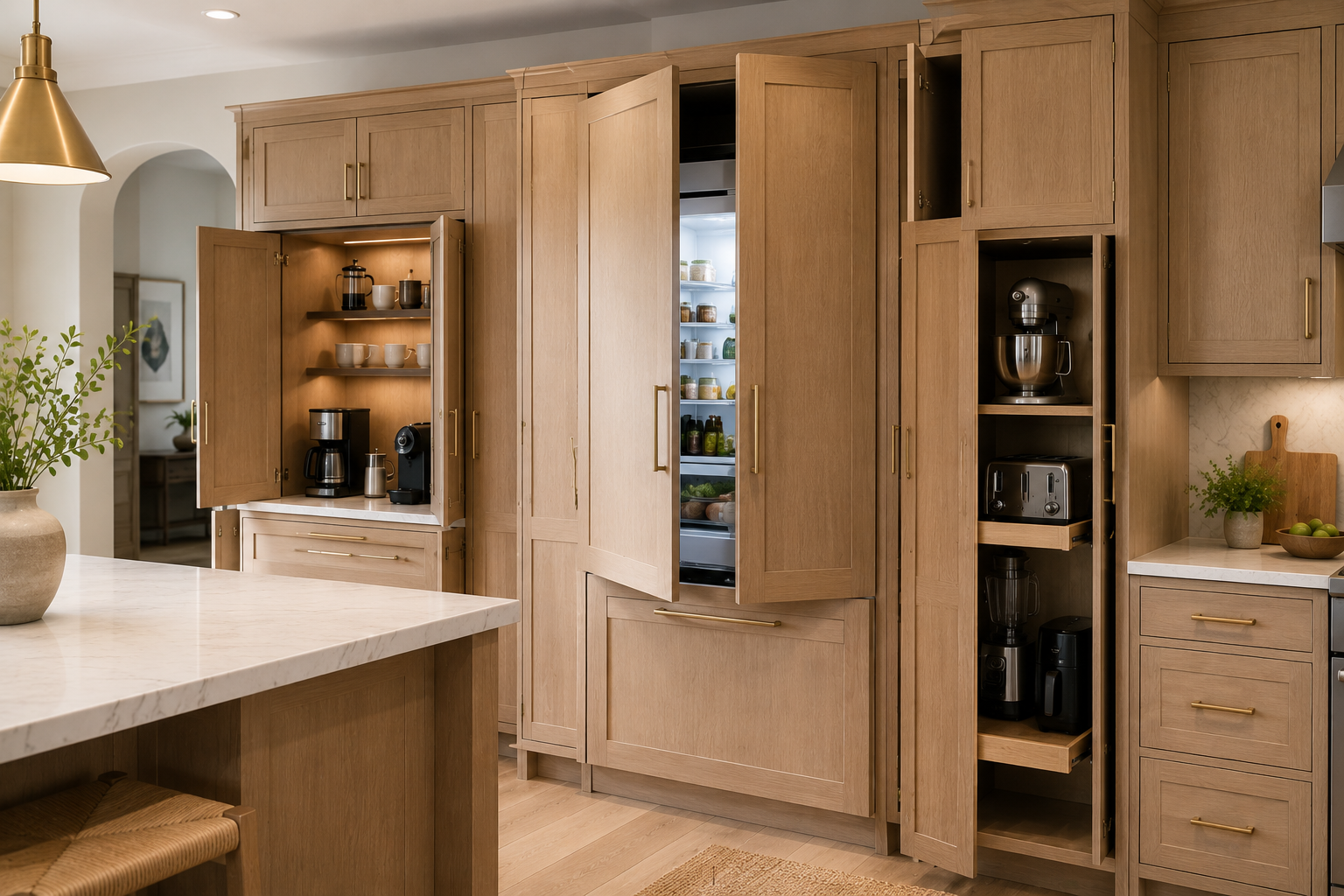
The Appliance Garage
An appliance garage is one of the most practical solutions for kitchens with multiple countertop appliances that are used regularly but do not need to be on permanent display. It is a dedicated cabinet section, typically in a corner or along a wall run, with a door, shutter, or tambour that rolls up or folds back to provide access when needed and closes to hide everything when not in use.
The best appliance garages are planned with power outlets already installed inside, so appliances can be left plugged in and ready to use without cords draping over the counter. A tambour door is the most common choice because it does not swing outward and take up workspace when open, but hinged versions with lift-up doors are also popular in taller cabinet runs.
Purpose-built cabinetry designed for appliance integration can incorporate ventilation slots, internal outlets, and shelving sized specifically for the appliances being stored, making the whole system considerably more functional than retrofitting a standard cabinet.
Panel-Ready Appliances
Panel-ready refrigerators and dishwashers are designed to accept a custom panel on their front face that matches the surrounding cabinetry exactly. When installed correctly, they become part of the cabinet run rather than interrupting it, and the kitchen reads as a unified surface of cabinetry rather than a mix of cabinetry and appliances.
This approach requires planning from the design stage, as the cabinetry, panel dimensions, and appliance clearances all need to be coordinated. It is not a retrofit solution but an intention that shapes the whole cabinet layout. The result, when done well, is one of the cleanest-looking kitchens possible.
Panel-ready dishwashers are particularly popular because dishwashers are low in the cabinet run and their stainless front panels are prominent. Matching a cabinetry-face panel to the rest of the lower cabinets makes the dishwasher functionally invisible, which is a significant visual improvement in an open-plan kitchen where the entire run is visible from the living or dining area.
Built-In Microwaves
A microwave sitting on the counter takes up a disproportionate amount of visual space and actual surface space given how often many households use it. Moving the microwave into the cabinetry is one of the single most impactful decisions for countertop clarity. Options include fitting it under an upper cabinet at eye level, building it into a column with other ovens, or integrating it into the island or a base cabinet run with a lower placement that suits shorter users and children.
Drawer microwaves, which pull out like a drawer rather than swinging open at the door, are popular for island integration because they work well at lower heights and have a clean, integrated appearance. They are typically slightly wider than conventional countertop microwaves but use the vertical dimension more efficiently.
The goal of reducing visual clutter on kitchen surfaces generally starts with the largest and least mobile items first, of which the microwave is usually the primary target.
Deep Drawers and Pull-Out Shelving for Small Appliances
Not every appliance needs to be within arm's reach at all times. A stand mixer, a waffle iron, a juicer, or any appliance used occasionally rather than daily is a good candidate for storage in a deep drawer or on a pull-out shelf within a lower cabinet. When needed, the shelf rolls out, the appliance is used in place or lifted onto the counter, and it returns to storage when done.
For smaller kitchens specifically, strategies to maximise storage in a smaller kitchen typically prioritise this exact approach: keeping only the most frequently used appliances accessible and housing everything else in organised, dedicated storage so the limited counter space is never dominated by things that are rarely used.
Coffee Station Design
Coffee makers occupy a special category because they are used daily, involve water lines and significant heat, and often come with a collection of accessories including grinders, capsule holders, frothers, and mugs that multiply the visual clutter. The most elegant solution is a dedicated coffee station with its own section of cabinetry, an integrated water line where possible, and storage for everything associated with the ritual immediately above or around the machine.
A coffee station that is designed as a zone rather than just a spot for the machine on the counter can be enclosed with a roll-up tambour or fold-back doors when not in use, so the whole area disappears into the kitchen surface at a glance. This works best when the station is planned from the beginning of the kitchen design rather than added afterward.
When thinking about which appliances to conceal versus display, the choice often connects to a broader decision about choosing between open and closed storage in the kitchen generally, since both decisions are about balancing accessibility, aesthetics, and the amount of visual editing you want to do on a daily basis.
Integrated Refrigerators in Column Design
Full-height integrated refrigerator columns are the premium version of appliance concealment. These are column-sized refrigerators and freezers that fit within a run of tall cabinetry and are fronted with a matching panel so they read as two tall cabinet doors rather than appliances. The result is a kitchen where all vertical storage, whether it contains food, pantry items, or cookware, appears to be part of a single cohesive cabinet run.
In a family-friendly kitchen design, an integrated refrigerator column also has the practical benefit of allowing the layout to separate refrigerator and freezer functions, placing the freezer higher where children cannot access it and the refrigerator at a level where everyone can reach what they need.
Frequently Asked Questions
What is an appliance garage and how does it work?
An appliance garage is a dedicated cabinet section, typically at counter level, designed to house small appliances behind a door or shutter when not in use. It usually includes internal power outlets so appliances remain plugged in and ready to use without being visible from the main kitchen. Tambour or lift-up doors are the most common closure types.
How do I hide a microwave in a small kitchen?
Built-in drawer microwaves work well in islands and under-counter locations in small kitchens. Alternatively, fitting a conventional microwave under an upper cabinet, at eye level between the uppers, is a common solution that frees up counter space without requiring significant cabinetry modification.
What are panel-ready appliances?
Panel-ready appliances are designed to accept a custom cabinetry-matched panel on their visible face so they blend seamlessly with the surrounding cabinets. Refrigerators and dishwashers are the most common panel-ready appliances. They require planning at the kitchen design stage to ensure the panels, hinges, and clearances are all coordinated correctly.
Should I hide all my appliances or just some?
The most practical approach is to conceal appliances you use occasionally while making frequently used ones accessible. Hiding a daily-use coffee maker behind a door that requires opening every morning may create more friction than the aesthetic gain is worth. Items used a few times per week or less are the best candidates for concealment.
Does hiding appliances add value to the kitchen?
Yes. A kitchen that reads as a unified surface of cabinetry without interruption from appliances is consistently regarded as more polished and premium in real estate assessments and buyer perception. Panel-ready appliances and well-executed appliance garages are among the details that distinguish a high-end kitchen from a functional but ordinary one.
The Bottom Line
Hiding appliances is one of the most effective ways to elevate the appearance of a kitchen without changing its functionality. The right strategy depends on which appliances you use daily, how much flexibility your cabinetry allows, and whether you are working within an existing kitchen or planning something new.
Kitchen Discounters can help you design cabinetry that integrates your appliances intelligently from the start. If you are planning a kitchen remodel or thinking about a significant update, get in touch to see what options fit your space and budget.