
How Do I Choose the Right Bar Stools for My Kitchen Island?
A kitchen island changes the way a kitchen is used. It creates a gathering point, a prep zone, a casual dining spot, and often the social centre of the whole room. But none of those functions work properly without seating that fits the space well, physically and visually. The wrong stools can make an island feel awkward, create uncomfortable overhang situations, or simply look out of place in a kitchen you have spent considerable time and money getting right.
The good news is that bar stool selection comes down to a handful of measurable factors and a few straightforward style decisions. Getting the height right is non-negotiable, but from there, the choices around style, material, and finish are more flexible than most people expect. Understanding the decisions in the right order prevents the most common mistakes.
Quick Answer: Choose bar stools by first measuring the counter height and selecting stools that leave 9 to 12 inches between the seat and the underside of the counter. Standard counter height is 36 inches, which calls for stools 24 to 26 inches tall. Bar height counters at 42 inches need stools 28 to 30 inches tall. From there, decide on back versus backless, swivel versus stationary, and a finish that complements your kitchen's existing materials.
Getting the Height Right
The single most important measurement in bar stool selection is the gap between the stool seat and the underside of the countertop overhang. Too little and knees are cramped and uncomfortable. Too much and the seated person is perching awkwardly with nowhere to rest their arms. The sweet spot is 9 to 12 inches, and every stool height decision should start from this number.
Standard kitchen counter height is 36 inches. For this height, counter stools in the 24 to 26 inch range are the right fit. If your island has a raised bar section at 42 inches, bar stools in the 28 to 30 inch range are needed. Always measure your actual counter height rather than assuming a standard, because older kitchens and custom islands frequently deviate from these norms.
Height-adjustable stools exist and can work well if multiple people of different heights use the island regularly, or if the island is used by both adults and children. The trade-off is that adjustable mechanisms can wear over time and may not look as clean as fixed-height stools in a polished kitchen.
Early kitchen island planning should establish counter height and overhang depth as part of the design so that seating choices are not constrained by an island that was not built with comfortable seating in mind.
How Many Stools Will Fit
The standard spacing recommendation is 26 to 30 inches from the centre of one stool to the centre of the next. This gives each person enough room to sit comfortably, shift position, and get on and off without bumping into their neighbour. Tight spacing is one of the most common regrets in island seating, so when in doubt, plan for fewer stools with more generous spacing rather than squeezing in an extra one.
Adequate traffic flow around the island requires at least 42 inches between the back of the stools when occupied and the nearest kitchen surface or wall, so the cook can move freely without dancers-at-a-party navigation around seated guests.
To calculate how many stools will fit, measure the full length of the seating overhang, subtract 6 to 8 inches from each end (to prevent the stools from sitting right at the edges and looking awkward), and divide the remaining length by 26 to 28 inches per person. This is the number of stools your island can comfortably accommodate.
Back or Backless
This choice is partly about comfort, partly about visual weight, and partly about how the kitchen is actually used. Stools with backs provide more support for long meals or extended sitting, which makes them a better fit if the island is a primary dining spot rather than just a casual perch. They also tend to look more intentional and substantial.
Backless stools have the practical advantage of tucking fully under the counter when not in use, which keeps the island looking tidy and uncluttered. They work particularly well in kitchens where the island is used for quick meals and seating is secondary, or in smaller spaces where visual minimalism matters. They also make it easier for children to climb on and off without pulling chairs away from the counter.
Stools with low backs represent a middle ground that many people find comfortable without the visual bulk of a full back. These tuck under the counter more easily than full-back stools and still provide lumbar support during longer seating.
Swivel Versus Stationary
Swivel stools make it easy to get on and off without having to push back from the counter, which is a meaningful practical benefit in a busy kitchen. They are a particularly good choice for island seating where the counter runs parallel to the main kitchen workspace, since a seated person can rotate easily to join a conversation or watch what is happening in the kitchen without an awkward twist.
Stationary stools are often simpler in design, more stable for young children, and tend to be available in a wider range of styles and price points. They work well in kitchens where seating is mostly parallel to the counter rather than perpendicular, or where the design priority is visual simplicity.
Material and Style
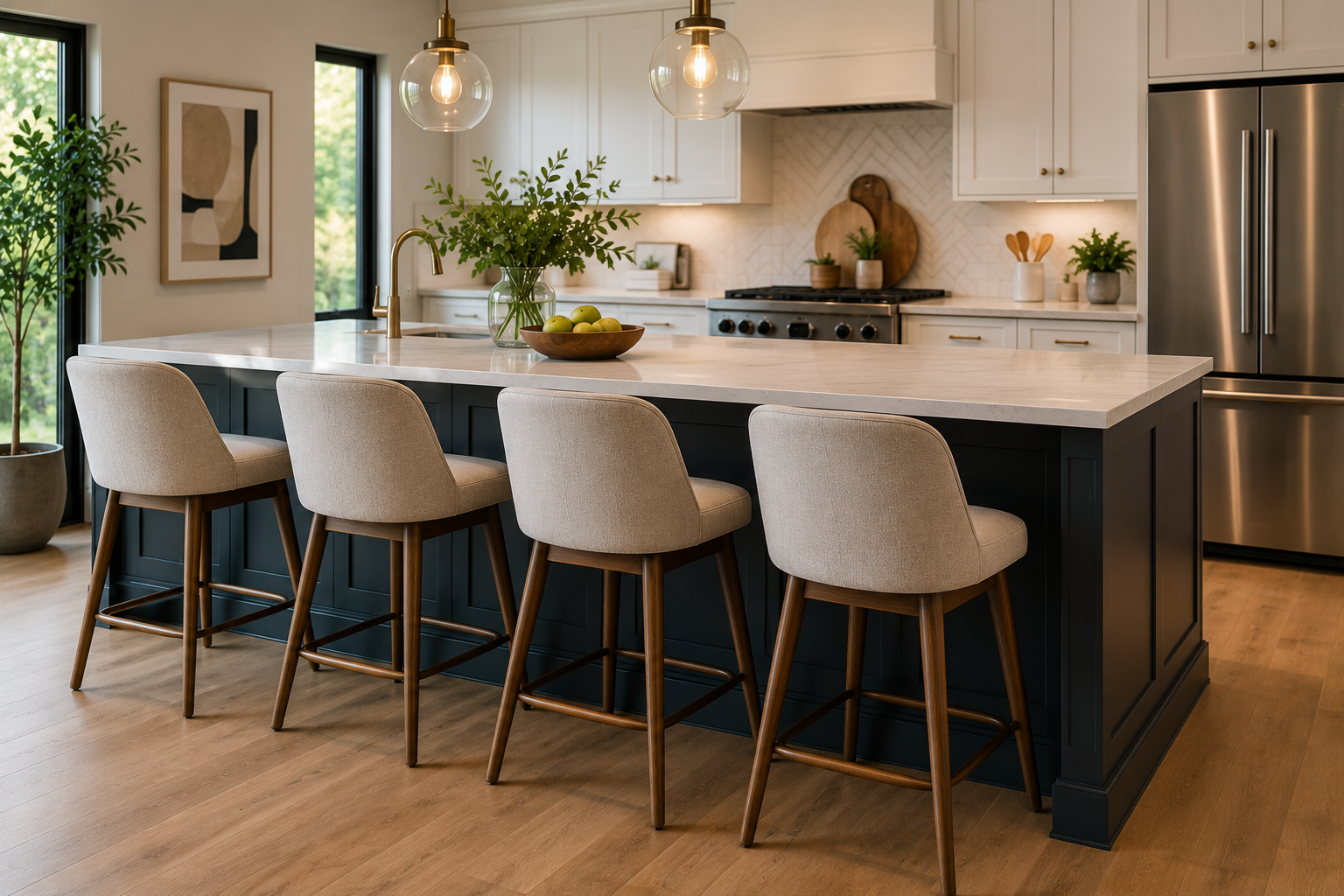
Bar stools come in wood, metal, upholstered, rattan, and various combinations. The material choice should connect visually to what is already in the kitchen. Metal stools suit contemporary and industrial kitchens. Wooden stools with natural grain suit transitional and traditional spaces. Upholstered stools in a solid colour or subtle pattern add warmth and sound absorption, which can be welcome in hard-surfaced kitchens.
Choosing a stool finish that echoes existing hardware and finish details in the kitchen creates visual cohesion without effort: a stool with brushed brass legs in a kitchen with brushed brass pulls and faucets reads as intentional and considered.
The overall colour palette for the kitchen should guide the stool colour too, whether that means picking up a warm wood tone to echo the cabinetry or introducing a contrasting upholstered seat in a shade pulled from a backsplash or accent wall.
If the kitchen has recently been updated with new cabinetry choices in a specific finish or material, the bar stools are an opportunity to reinforce that direction or provide a thoughtful contrast that adds interest without clashing.
Frequently Asked Questions
What is the most comfortable seat height for a standard kitchen counter?
For a standard 36-inch counter, stools in the 24 to 26 inch range are most comfortable for the average adult. The goal is 9 to 12 inches of clearance between the seat and the underside of the counter overhang.
Can I mix different bar stool styles at the same island?
Mixing is possible and can look intentional when done carefully. The most common approach is to keep the same seat height and overall silhouette while varying a detail like material or colour. Random mixing of completely different stool styles tends to look accidental rather than curated.
How deep should my island overhang be for comfortable seating?
A minimum of 12 inches of overhang provides enough knee clearance for comfortable seating. 15 inches is more comfortable for most people and is the preferred minimum for a primary dining spot. Less than 12 inches typically forces the seated person to sit at an uncomfortable angle.
Are backless stools more practical for everyday use?
For casual daily use, backless stools that tuck fully under the counter are very practical. For extended meals or households with children who need stability when sitting, backed stools typically provide a better experience despite their larger footprint.
What material is easiest to keep clean for kitchen bar stools?
Metal and solid wood are generally the easiest to wipe clean. Upholstered stools with performance fabric or leather are manageable but require more attention to spills. Wicker and rattan look beautiful but are harder to clean thoroughly and are not well-suited to kitchen areas with significant cooking mess.
The Bottom Line
The right bar stools start with the right height, followed by the right number for the space, then the style and material choices that fit how the kitchen looks and is used. Getting the measurements right first prevents the most common and most frustrating mistakes.
Kitchen Discounters can help you plan your island seating as part of a broader kitchen design that ensures everything works together. If you are working through an island redesign or a full kitchen refresh, visit or reach out to discuss your project.